
Research · 2026-09-22
Quantum Machine Learning: Two Paradigms, One Research Frontier
An introduction to how quantum computing and machine learning may combine in hybrid systems, alongside the limits of present-day hardware.
Research question
Literature analysis
Under what conditions can quantum-computing methods offer a meaningful advantage for machine-learning tasks, and what kind of evidence would establish it?
Context
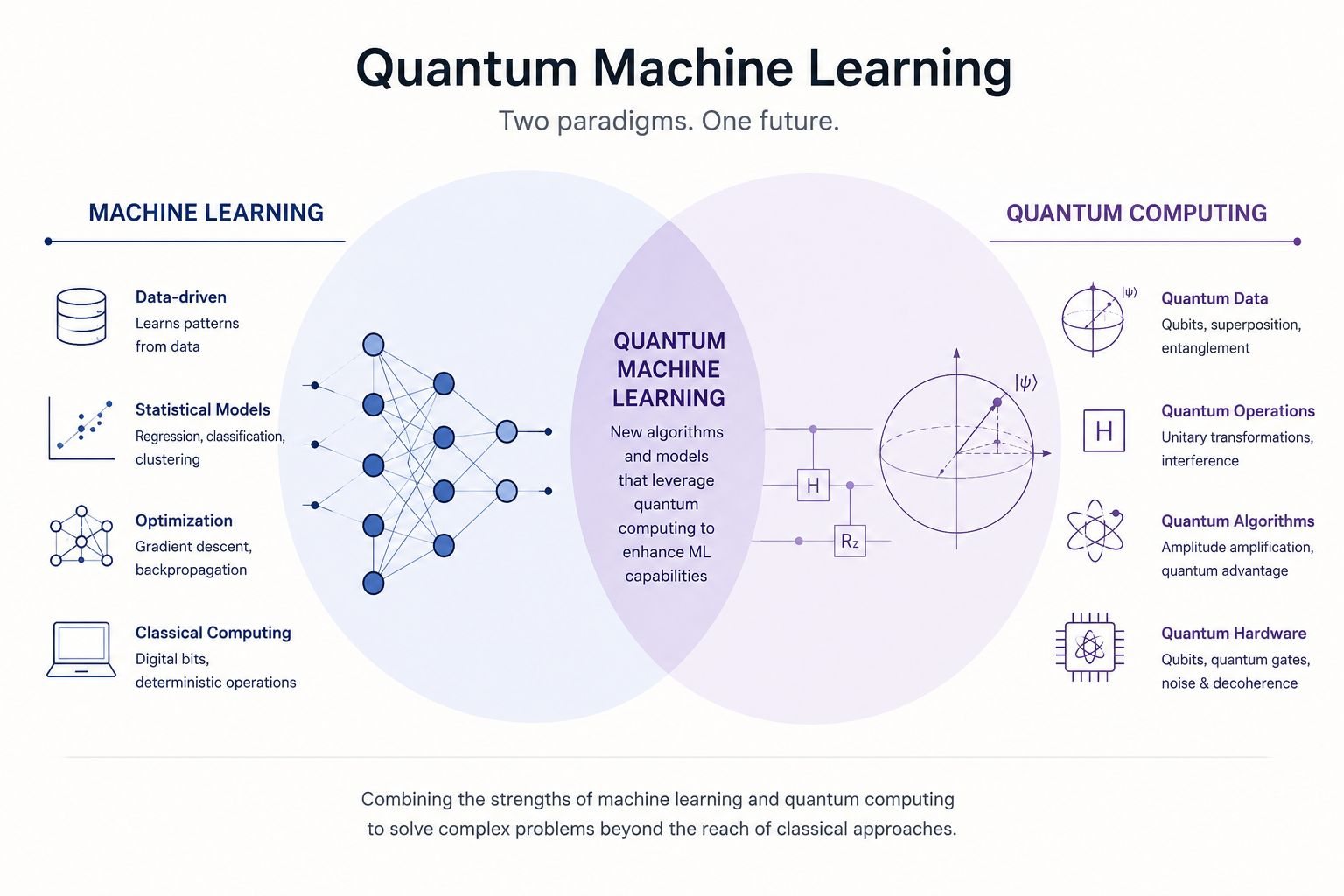
Quantum Machine Learning (QML) studies how quantum-computing methods and machine-learning methods might work together. It is not a replacement for classical machine learning; it is a research area exploring whether particular learning and optimization tasks can benefit from quantum representations or quantum algorithms.
Common directions include quantum principal component analysis for dimensionality reduction, quantum support-vector and kernel methods for classification, parameterized quantum circuits sometimes described as quantum neural networks, and quantum optimization methods such as QAOA. These names identify families of methods, not interchangeable solutions to every ML problem.
Evidence examined
This analysis draws on peer-reviewed survey literature covering the QML method families above (see References), and on the publicly documented constraints of current quantum hardware: noise, decoherence, limited scale, and the cost of moving data between classical and quantum components.
No original experiments were performed for this article. Simulator results, small hardware demonstrations, and theoretical speedups reported in the literature are treated as distinct kinds of evidence, not as interchangeable proof of practical advantage.
Methodology
Claims encountered in the survey literature were sorted into three evidence tiers: theoretical speedup, simulator result, and useful result on available hardware. A claim is only treated as practically relevant when it clears the third tier for a clearly defined problem.
Evaluation is task-specific throughout: the question asked of each method family is whether a hybrid quantum-classical workflow offers a meaningful computational or modeling advantage for a defined workload — never whether quantum computing makes machine learning better in general.
Analysis
The central technical question is task-specific: can a hybrid quantum-classical workflow offer a meaningful computational or modeling advantage for a clearly defined problem? A theoretical speedup, a simulator result, and a useful result on available hardware are different kinds of evidence, and much QML discussion conflates them.
The available evidence suggests QML remains an active research frontier rather than a technology verdict. Its promise lies in careful evaluation of specific methods and workloads — particular circuits, datasets, and simulators or hardware — rather than in a general claim of superiority.
Key findings
Advantage claims must specify task, representation, and hardware
A QML result is only interpretable when the workload, the quantum representation used, and the execution environment (theory, simulator, or specific hardware) are all stated. General superiority claims do not follow from task-specific results.
Data loading and noise bound near-term relevance
The reported literature consistently identifies the cost of moving data between classical and quantum components, together with noise and decoherence, as the binding constraints on current hardware — independent of algorithmic ingenuity.
Hybrid workflows are the unit of evaluation
The meaningful comparison is between hybrid quantum-classical workflows and classical baselines on defined problems, not between paradigms in the abstract.
Limitations
This is a literature analysis, not an original experiment: no circuits were run, no benchmarks were executed, and no new measurements are reported here.
Survey literature moves quickly; specific results may have been extended, qualified, or superseded since publication. The references below are entry points, not an exhaustive review.
Hardware constraints described here reflect publicly documented device characteristics and may change as devices evolve; any practical conclusion is conditional on the hardware generation evaluated.
The article does not establish practical quantum ML superiority for any workload. Theoretical potential, simulation results, and small demonstrations should not be read as production relevance.
References
Further work
Evaluate specific hybrid quantum-classical workflows against classical baselines on defined workloads as hardware capabilities evolve, reporting task, representation, and execution environment for each result.