
Research · 2026-09-22
From Noise to Decision Advantage
A reading note on AI as a signal-extraction and decision-support layer when information is incomplete, noisy, delayed, or contradictory.
Research question
Technical analysis
How should AI systems be positioned when decisions must be made from incomplete, noisy, delayed, or contradictory information?
Context
This reading note considers the framing in Mission Command's Asymmetric Advantage Through AI-Driven Data Management, published in Parameters by the U.S. Army War College. It addresses a familiar decision problem: how to work with information that is incomplete, noisy, delayed, and sometimes contradictory.
Evidence examined
The material examined is a single conceptual source: the Parameters article above. No experiments, datasets, or model evaluations were examined for this note, and none are claimed.
Methodology
The source's doctrinal framing was translated into technical terms — asking which of its claims correspond to known machine-learning concepts such as feature extraction, noise suppression, pattern detection, and prioritization — and checked for what it does not establish: it contains no evaluation showing that a particular model improves real-world outcomes.
Analysis
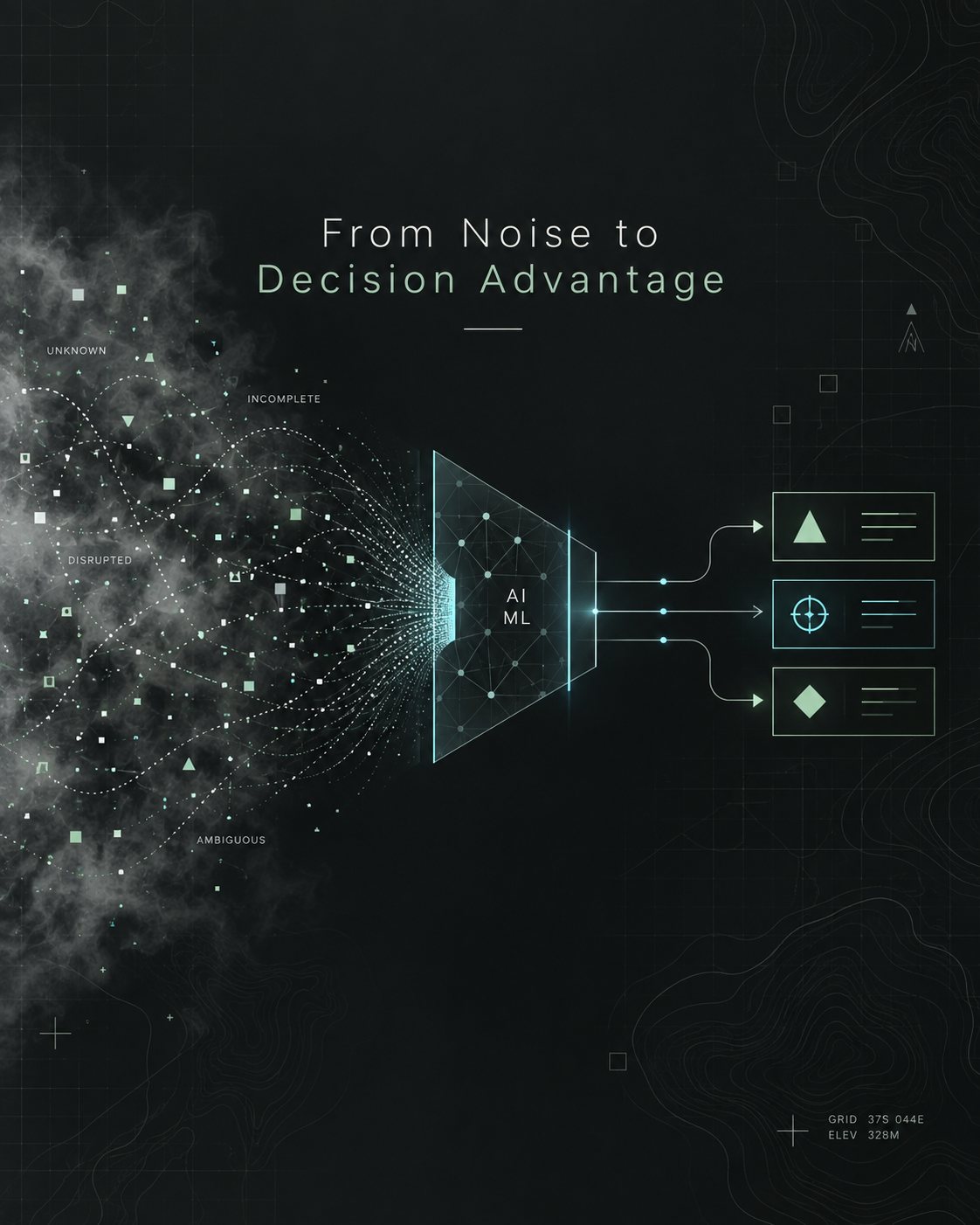
The useful technical interpretation is not that an AI system replaces human command. It is that machine-learning systems can serve as a signal-extraction layer: transforming high-dimensional input into more structured, decision-relevant representations. Feature extraction, noise suppression, pattern detection, and prioritization are relevant concepts, but they do not remove uncertainty.
This makes AI most useful as decision support. It can help surface weak signals, expose correlations worth examining, and organize information for consideration. Human judgment, accountability, and context remain essential when a decision has operational consequences.
Key findings
AI as signal-extraction layer, not decision authority
The analysis supports positioning machine learning as a layer that structures noisy input for human consideration — surfacing signals and correlations — rather than as the locus of the decision itself.
Uncertainty persists after processing
Noise suppression and prioritization reduce but do not remove uncertainty; the residual uncertainty is precisely where human judgment and accountability remain essential.
The source is conceptual, not evaluative
The Parameters article contributes a framing and a boundary, not evidence that any particular system improves outcomes. Its value here is the boundary it draws: technology can support decision quality without becoming the decision authority.
Limitations
This note analyzes one conceptual source; it reports no measurements, comparisons, or evaluations of its own.
The source's doctrinal and organizational context (military command) may not generalize to other decision settings; the transfer of its framing to civilian or commercial workflows is interpretive, not established.
No claim is made that signal-extraction systems improve real-world decision outcomes — that would require controlled evaluation, which neither the source nor this note provides.
References
Further work
Empirically evaluate signal-extraction quality — precision, recall, calibration under noise — for specific decision-support workflows, rather than treating the framing as validated.