
Project
Inventory & Supply Chain Management Platform
An integrated platform for inventory, supply-chain operations, demand planning, traceability, and carefully bounded AI assistance.
Prototype · 2026-09-22
Problem
Inventory and supply-chain work runs on disconnected files, systems, and manual calculations. Operations need one workflow covering stock, movement, planning, and traceability with accountable controls.
Context
The platform was designed to replace disconnected files, systems, and manual calculations with one operational workflow for inventory and supply-chain management.
Constraints
- Every stock change must be traceable through an immutable movement history with controlled corrections — no silent edits.
- Batches and expiry dates require FEFO allocation; ordering must translate into actual supplier packaging.
- Private operational data, customer information, and internal infrastructure are excluded from this public case study.
Architecture
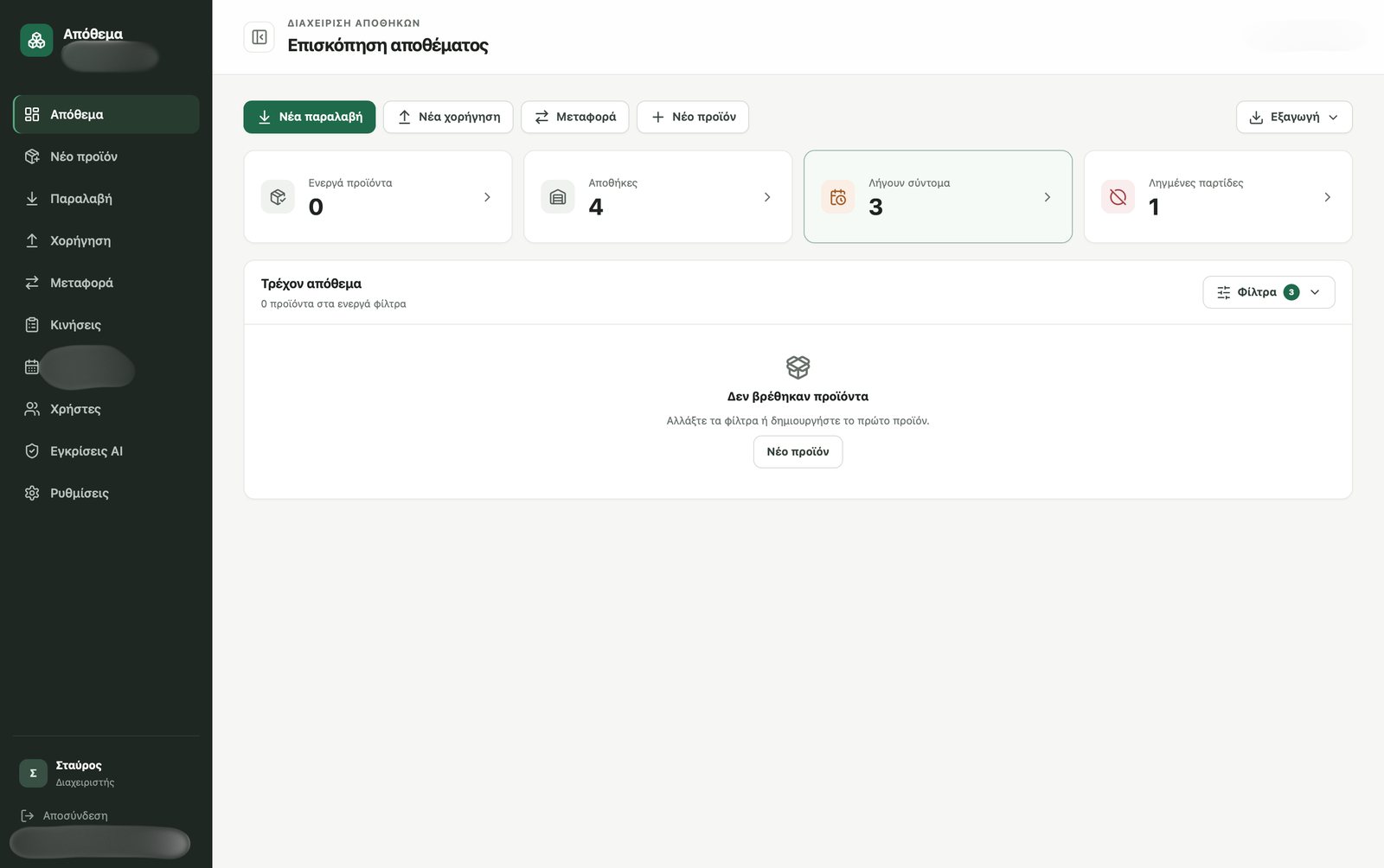
The platform layers an operational workflow over a ledger-style data core: catalog and supplier data feed warehouse stock records, every movement is logged immutably, planning derives from recorded history, and role-based access gates every action.
- Catalog and suppliersProducts, suppliers, packaging definitions, and barcode mappings.
- Warehouse stock ledgerGoods receipts, issues, and internal transfers across multiple warehouses with immutable movement history.
- Batch and expiry trackingBatch identity with FEFO allocation for perishable or dated stock.
- Demand planningEstimates future requirements, expected consumption, and projected stock from operational data.
- Access and auditRole-based access, action logging, and desktop plus mobile access for accountable operations.
- Agent interface (planned)A future MCP connection for bounded retrieval, calculations, and proposed actions — not yet implemented.
Data
The system records products, suppliers, packaging, warehouses, batches with expiry, and every stock movement. Planning estimates derive from this recorded history. All private operational data and customer information are excluded from the public case study.
Implementation
It supports products, suppliers, packaging, and multiple warehouses; goods receipts, issues, and internal transfers; batches and expiry dates with FEFO allocation; barcode mapping; and an immutable movement history with controlled corrections.
Using operational data, the system can estimate future requirements, expected consumption, and projected stock. It can identify shortages and translate required quantities into the actual supplier packaging used for ordering.
Role-based access, action logging, and desktop and mobile access support accountable everyday operations.
AI / ML role
AI involvement is a planned MCP connection enabling natural-language information retrieval, calculations, and proposed actions within clearly bounded operational workflows. It is not an implemented component, and no AI behavior is evaluated in this case study.
Evaluation
No formal evaluation is reported: no performance benchmarks, load tests, user studies, or production-traffic validation. The implementation demonstrates the described workflows without measured evidence of reliability, scale, or operator effectiveness.
Results
One accountable workflow
Catalog, multi-warehouse stock, batch traceability, and planning estimates operate on a single ledger with immutable history instead of disconnected files.
Packaging-aware ordering
Shortages translate into actual supplier packaging quantities, closing the gap between a computed requirement and an orderable one.
Bounded AI extension point
The MCP interface is scoped to retrieval, calculations, and proposed actions — AI proposes within workflows it cannot silently execute.
Limitations
This prototype has no reported production deployment; scale, concurrency, and failure behavior are untested.
The AI agent connection is designed but not implemented, so all AI-related claims are prospective.
No evaluation with real operators exists; workflow fit for daily operations is unproven.
Lessons
An immutable movement history with controlled corrections makes every stock figure auditable — accountability is a data-model property, not a policy document.
Ordering logic must speak in supplier packaging, not abstract units; the last-mile translation is where planning systems usually fail operators.
Scoping AI to proposed actions inside human-approved workflows bounds risk before any model is connected.