
Project
Hotel Booking Risk Intelligence
A business-facing Machine Learning demo that turns booking-cancellation predictions into practical revenue-risk context for hotel management.
Prototype · 2026-09-22
Problem
Booking-cancellation predictions typically end as notebook outputs. Hotel managers need revenue-risk context they can act on before a cancellation occurs, not a raw model score.
Context
The project explores how booking-cancellation predictions can become useful revenue intelligence for hotels, rather than ending as a notebook-only model output.
The intended direction is AI revenue intelligence for small and mid-sized hotels: helping teams understand exposed revenue and consider appropriate actions before a cancellation occurs.
Constraints
- Predictions must be translated into operational context — exposed revenue, risk distribution, timing — rather than presented as raw scores.
- All figures shown are synthetic demo signals for a business conversation, not measured outcomes.
- Customer data, proprietary hotel information, and private infrastructure are excluded from this public case study.
Architecture
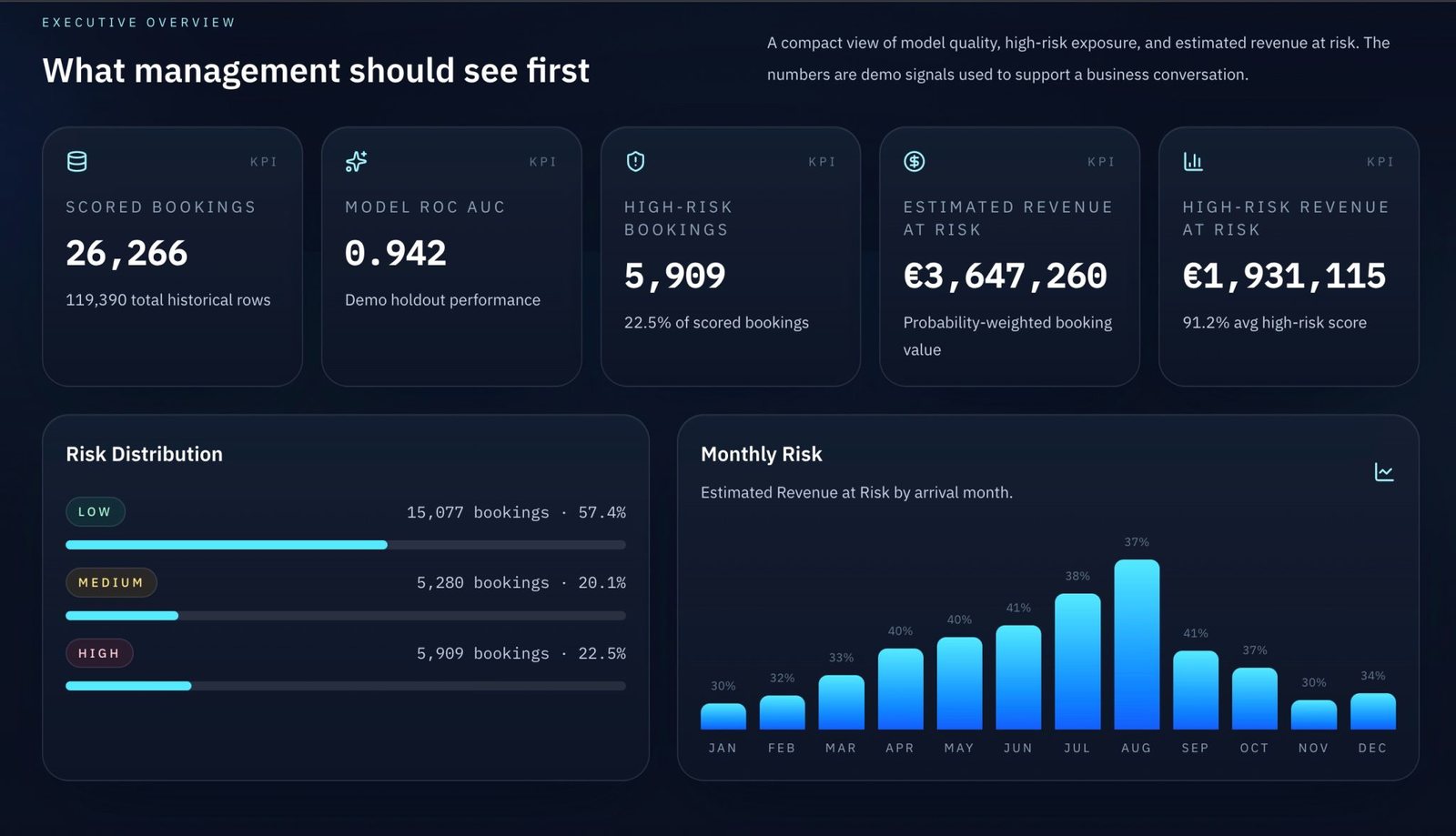
The demo is organized as a prediction-to-dashboard flow: cancellation-risk scoring feeds a management view that aggregates high-risk bookings, estimated revenue at risk, risk distribution, monthly patterns, and suggested actions.
- Risk scoring (demo)Produces per-booking cancellation-risk signals consumed by the dashboard.
- Management dashboardAggregates risk views so a decision-maker sees the operational context around each prediction.
- Suggested actionsMaps risk segments to candidate management responses for discussion, not automated execution.
Data
The demo works from booking-level records of the kind standard cancellation-prediction features use. Every figure displayed is a synthetic demo signal; no customer or production data is involved.
Implementation
The demo brings together high-risk bookings, estimated revenue at risk, risk distribution, monthly cancellation patterns, and suggested management actions so a decision-maker can see the operational context around a prediction.
AI / ML role
The demo assumes a cancellation-risk classifier upstream of the dashboard. Model training, feature engineering, and performance metrics are not part of this case study, and no modeling claims are made here.
Evaluation
No formal evaluation is reported: no accuracy, calibration, revenue-impact, or user-study measurements exist for this demo. Assessment is limited to whether the demo communicates risk context effectively in a business conversation.
Results
Prediction output becomes management context
The demo shows cancellation risk as exposed revenue, distributions, and timing — the form in which an operational decision-maker can actually use it.
Responsible framing preserved
Demo signals are explicitly labeled as such throughout, so the business conversation never mistakes illustration for measured performance.
Limitations
This is a prototype demo, not a deployed system: nothing here has served production traffic or real hotel data.
No model performance is reported, so nothing is known about prediction quality on real bookings.
No validation with hotel operators has been conducted; whether the views match real decision workflows is untested.
Lessons
Operational users need risk translated into revenue and timing context; raw model scores do not drive action on their own.
Labeling demo signals explicitly preserves trust and keeps the business conversation honest about what is proven.