
News · 2026-09-22
Constraining non-deterministic agents with deterministic process
A practice-derived pattern for making AI-assisted engineering workflows predictable, inspectable, and bounded.
What it is
This note is about a practical pattern for AI-assisted software development: keeping the agent’s reasoning flexible while wrapping it in a process that is as deterministic as possible. The goal is not to make the model deterministic. The goal is to make the workflow around the model predictable, inspectable, and bounded.
Core technical characteristics
- Narrow, single-task scope: one concrete change at a time.
- Explicit constraints on what must not change, including the forbidden surface.
- Clear definition of done with expected tests and API behavior.
- Tests as hard boundaries that define the acceptable output space.
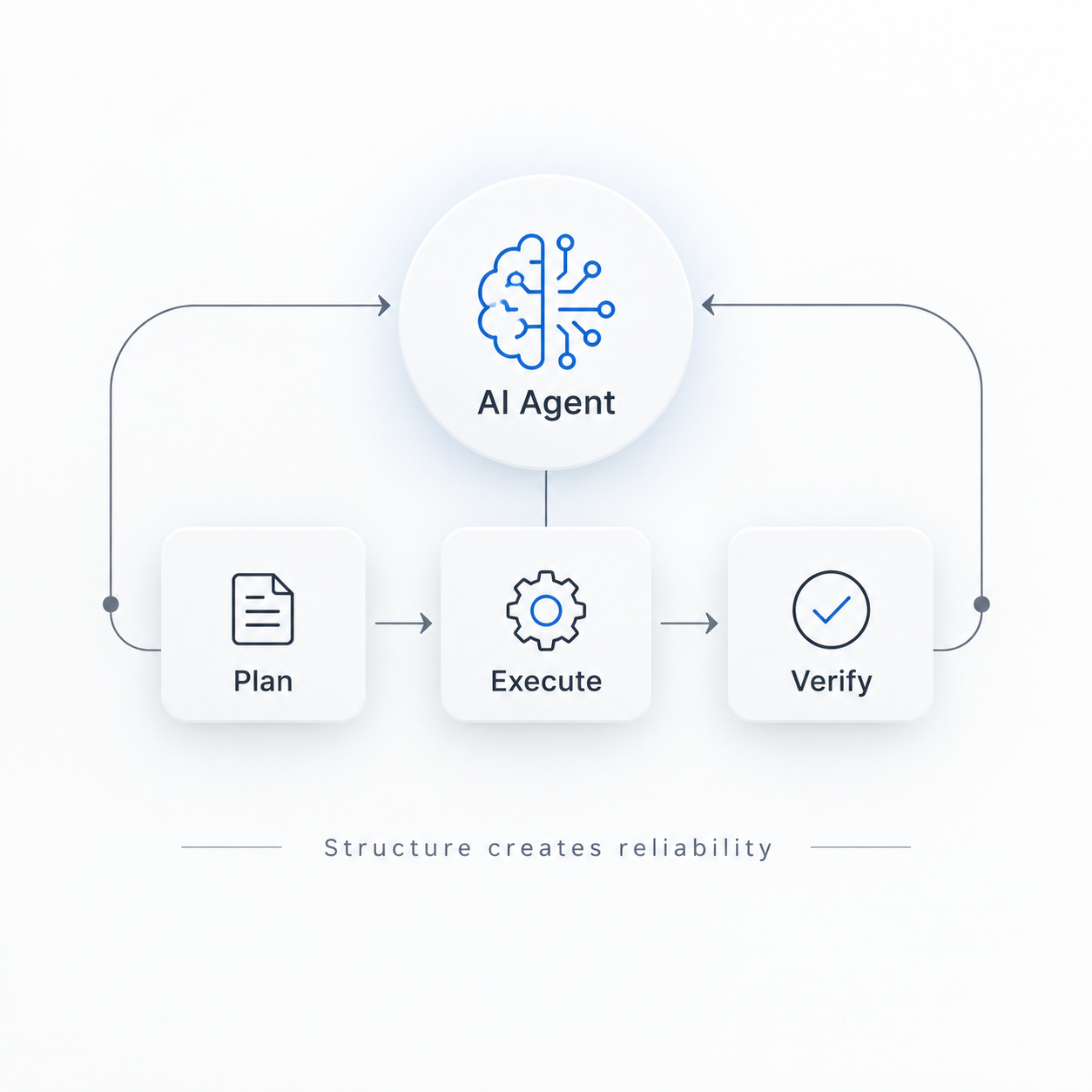
- Plan → Execute → Verify: state the change, perform it, then report outcomes.
Why it matters
As agents take on more of the implementation loop, reliability depends on the process that surrounds them. Tight scope, explicit constraints, measurable completion criteria, tests as boundaries, and a plan–execute–verify cadence create a controlled engineering step.
The pattern also applies beyond coding agents: generative planning or action benefits from deterministic routing, approval gates, verification, and rollback conditions.
Limitations and open questions
The pattern improves controllability; it does not eliminate non-determinism inside the model. Different runs can still produce different valid solutions that pass the same tests.
Overly tight constraints can block useful exploration; the appropriate constraint level depends on risk and test maturity.
Definitions of done and test coverage are only as strong as the tests themselves.
Plan–execute–verify adds latency and token cost.
This is practice-derived guidance, not a formal method with independent benchmarks across agent systems.